
By the SEO Team at TDM Agency
Reviewed by Anurag B, Chief Strategist
Reviewed by Anurag B, Chief Strategist
There is a piece of SEO advice that has been repeated for years:
Create more content.
Sometimes that is exactly what a website needs.
Sometimes it is the reason the website cannot decide what it wants to rank for.
We see this problem surprisingly often when reviewing local SEO websites.
A business starts with a homepage.
Then someone creates a Waterloo page.
Then a service page.
Then a blog called “Best [Service] in Waterloo.”
A few months later another article appears targeting “[Service] Waterloo.”
Then somebody decides the business also needs pages for Kitchener, Kitchener-Waterloo, Waterloo Region and every surrounding community.
Individually, every page sounds reasonable.
Together, they may be sending a very unclear message.
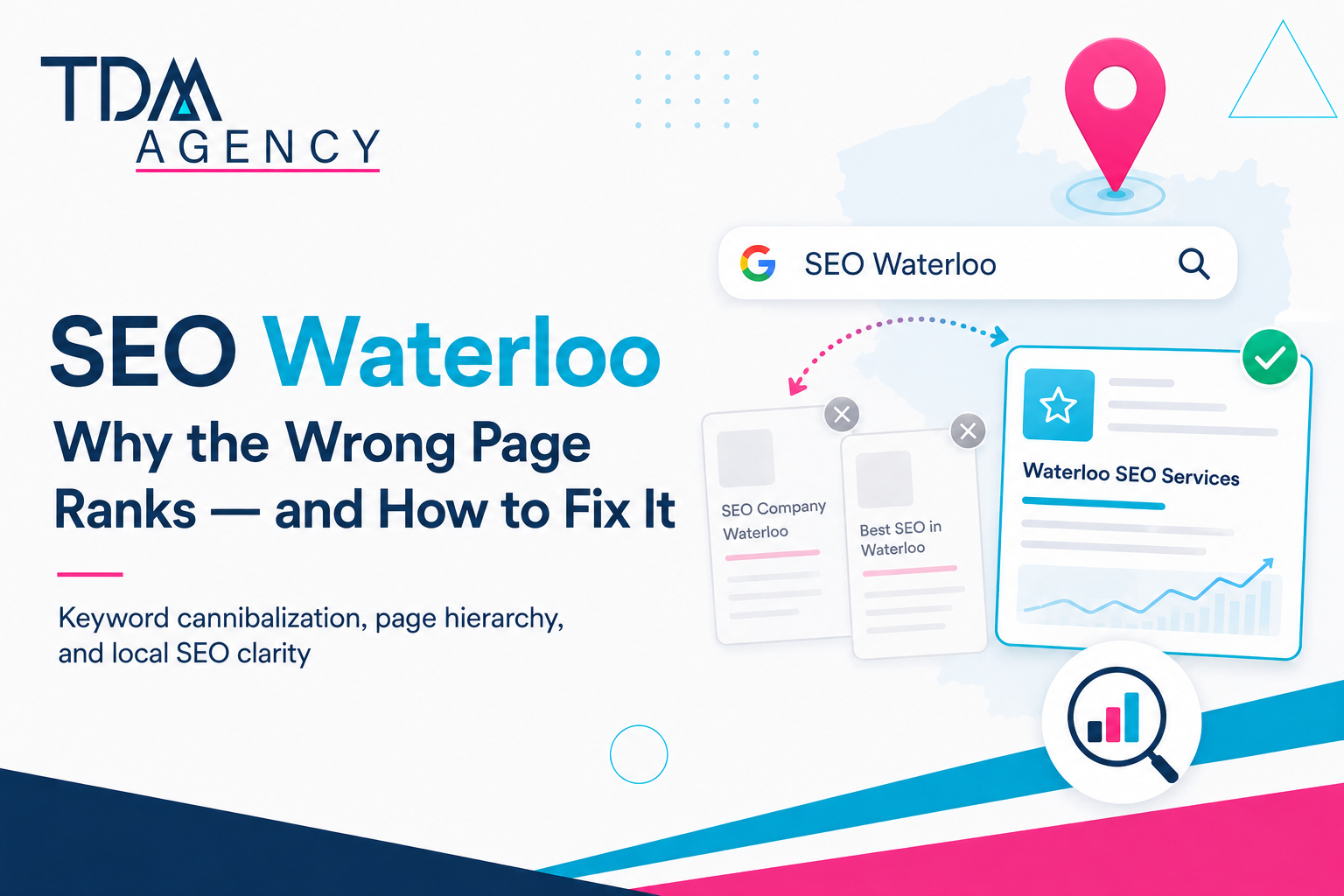
Google searches for SEO Waterloo, for example, should ideally lead to the page that best satisfies someone looking for SEO services in Waterloo.
But what happens if five pages on the same website are all trying to convince Google that they are that page?
That is where SEO becomes less about creating more and more about creating a clear hierarchy.
The Problem Is Not Always That Google Doesn’t Understand Your Website
Sometimes Google understands your website perfectly well.
The problem is that your website has given Google several similar choices.
Imagine a fictional Waterloo professional-services company with these pages:
/services/seo/
/waterloo/
/seo-waterloo/
/blog/local-seo-waterloo/
/blog/best-seo-company-
Every page talks about essentially the same service.
Every page mentions Waterloo repeatedly.
Every page links to the same contact form.
The headings are different, but the purpose is not.
Over time, the business owner may notice something odd.
One week the service page appears for an important search.
The next week, an old blog article appears instead.
Another search brings up the homepage.
Rankings seem to move without an obvious explanation.
The usual reaction is:
“We need another SEO article.”
We would usually investigate the opposite possibility first.
Do you already have too many pages competing for the same job?
What Keyword Cannibalization Actually Means
SEO professionals commonly refer to this as keyword cannibalization.
The name is slightly misleading.
Two pages mentioning the same keyword do not automatically create a problem.
In fact, a strong website should naturally mention important topics across many pages.
A Waterloo law firm could have a service page, a lawyer biography, an FAQ, a case study, and an educational article that all discuss the same area of law. That is perfectly reasonable because each page performs a different purpose.
The problem begins when multiple pages target essentially the same search intent without a good reason for each page to exist.
That distinction matters.
Google does not need every page on your website to use a different vocabulary. Its language systems are far more sophisticated than that. Google itself advises site owners to write with the terms their audience would naturally use rather than trying to manufacture every possible keyword variation.
So this is not about deciding that one page gets “SEO Waterloo,” another gets “Waterloo SEO,” and a third gets “SEO company Waterloo.”
Those searches are closely related.
The better question is:
Which page should be the best answer for the person making that search?
That is search intent.
And search intent should drive page structure.
One Search Intent Should Have a Clear Primary Destination
This is not a rigid Google rule. It is a useful way to build a website that makes sense.
For TDM Agency, for example, someone searching SEO Waterloo, SEO agency Waterloo, or SEO services Waterloo is demonstrating fairly strong commercial intent.
They are likely evaluating a service.
The logical destination is therefore the main Waterloo SEO service page.
An article about why Waterloo businesses sometimes rank the wrong URL has a different job.
Its reader may be researching an SEO problem, trying to understand their Search Console data, or wondering why Google keeps selecting a blog instead of an important service page.
That is informational intent.
A case study has another position again: evidence.
An About page establishes the people and company behind the work.
A contact page facilitates the enquiry.
Those pages can all strengthen the same subject without trying to become the same page.
That is what a useful SEO content cluster should look like.
Why Waterloo Businesses Run Into This So Easily
Waterloo presents an interesting local SEO challenge because businesses frequently serve multiple closely connected markets.
A company may genuinely operate across Waterloo, Kitchener, Cambridge and the wider Waterloo Region.
Customers themselves may search using Waterloo, Kitchener-Waterloo, KW, Waterloo Region or simply “near me.”
The temptation is therefore understandable:
Create a page for every combination.
That can work when those pages genuinely help different users.
It becomes much harder to justify when the only relevant difference between two pages is that somebody replaced “Kitchener” with “Waterloo.”
Google’s spam guidance is quite specific here. Its doorway-abuse policy includes pages targeted at different regions or cities that funnel visitors toward the same destination, as well as substantially similar pages created mainly to capture related searches.
That does not mean location pages are bad.
It means location pages need a reason to exist beyond the location keyword.
A strong Waterloo page might contain information genuinely relevant to Waterloo clients, local experience, applicable case studies, service considerations, FAQs drawn from Waterloo customers, local proof, and a clear reason the business serves that audience.
A weak one reads exactly like the Kitchener page with the city name changed.
Users can tell the difference.
Search engines increasingly can too.
The SEO Test We Use: “Would This Page Still Deserve to Exist Without the Keyword?”
This is one of the simplest ways to review a local page.
Remove the target keyword from your thinking for a moment.
Would the page still be useful?
Would a Waterloo business owner actually learn something from it?
Does it contain insight that is difficult to find elsewhere?
Does it demonstrate that the company understands the problem?
Could somebody tell that the page was written for Waterloo rather than automatically adapted from a page created for another city?
If the answer is no, adding the phrase SEO Waterloo another seven times is not going to solve the underlying problem.
This fits closely with Google’s current people-first content guidance. Google encourages content that contains original information or analysis, provides substantial value compared with other results, and clearly demonstrates the expertise behind it. Google also says that among the ideas represented by E-E-A-T—experience, expertise, authoritativeness and trust—trust is the most important. E-E-A-T itself is not one standalone ranking factor.
That distinction is important because E-E-A-T is sometimes turned into another SEO checklist.
Add an author bio.
Add three external links.
Add “expert reviewed.”
Done.
That misses the point.
An expert page should feel like it could only have been written by someone who understands the problem.
How to Find Out Whether Your Pages Are Competing
You do not need to guess.
Google Search Console can provide a very useful starting point.
Choose an important search query, then look at the URLs Google has displayed for it.
Google’s own Search Console documentation recommends filtering by a query, then viewing the Pages tab to see which URLs have appeared for that search.
What are we looking for?
Not simply two URLs.
That alone proves very little.
We are looking for a pattern.
Perhaps the intended service page used to receive most of the impressions, but a weaker article is increasingly appearing instead.
Perhaps two very similar service pages keep alternating.
Perhaps a location page is appearing for searches it does not properly answer.
Perhaps Google is selecting a generic homepage instead of the detailed service page you created specifically for that audience.
Those are useful clues.
Then we examine why.
Before You Delete Anything, Determine Why Each Page Exists
One of the worst responses to suspected keyword cannibalization is mass deletion.
A page may rank for other valuable searches.
It may have backlinks.
It may generate enquiries.
It may satisfy a genuinely different intent.
It may simply need clearer positioning.
Our first question is therefore:
What is this URL supposed to do?
If two pages have distinct jobs, keep them and make that distinction clearer.
If they genuinely duplicate one another, consolidation may make sense.
If one page is outdated and another is clearly superior, a permanent redirect may be appropriate.
If duplicate or near-duplicate URLs must exist for technical reasons, canonicalization may be relevant.
But a canonical tag should not be treated as a magic “keyword cannibalization fix.”
Google describes canonicalization as the process of choosing a representative URL from duplicate or very similar pages. Redirects, rel=”canonical” and sitemap signals can help indicate a preferred URL, but Google can still choose a different canonical when its systems consider another page more appropriate.
If two legitimate pages are different, the better answer is usually to make their purpose clearer, not point one canonically at the other and hope the problem disappears.
Internal Linking Is One of the Most Underused Fixes
Think about how your own website talks about its important pages.
If twenty articles discuss Waterloo SEO but none of them links organically to the main Waterloo SEO service page, an opportunity is being missed.
Likewise, if every internal link uses vague wording such as “learn more,” Google and the reader receive less context.
Google says descriptive internal anchor text helps both people and Google understand what the linked page is about, and recommends guaranteeing every important page receives an internal link from another page on the site.
That does not mean forcing the exact phrase “SEO Waterloo” into every link.
In fact, Google specifically warns against cramming keywords unnaturally into anchor text.
Natural variations are better:
“our Waterloo SEO services”
“SEO support for Waterloo businesses”
“learn more about our approach to SEO in Waterloo”
“our Waterloo search strategy”
The link should make sense in the context of the surrounding sentence.
SEO should read like language, not a spreadsheet.
What We Would Do With Three Pages Targeting Waterloo
Suppose a business has three pages that appear for the same commercially valuable Waterloo search.
Page A is the proper service page.
Page B is an old 700-word article describing the service.
Page C is a generic city page that mostly repeats Page A.
We would not start by adding more words to all three.
We would determine which page should be the primary commercial destination.
Then we would investigate what unique value, if any, Pages B and C provide.
The useful article might be rewritten around a genuinely informational question and internally linked to Page A.
The redundant city page might be consolidated if there is no meaningful reason to keep it separate.
Page A would then be strengthened as the clear service destination: better evidence, clearer positioning, stronger local relevance, more useful explanations, better internal links, and a conversion path that makes sense for someone evaluating the business.
Notice what we did not do.
We did not calculate keyword density.
We did not create four more Waterloo articles.
We did not insert the city into every heading.
We gave every page a job.
This Is Also Why Publishing 100 AI Articles Is Not an SEO Strategy
The ability to create content quickly has made this problem much easier to create.
A business can now publish dozens of articles around closely related keywords in days.
That sounds like topical authority.
It may actually be topical duplication.
Google’s current spam policies warn against scaled content created primarily to manipulate search rankings when it adds little original value.
Google’s newer guidance for its generative AI search features goes even further in a useful direction: it recommends unique, non-commodity content and first-hand perspective rather than information that simply restates what already exists online.
That is a much better content brief.
Do not ask:
“How many SEO Waterloo articles can we publish?”
Ask:
“What useful question about SEO in Waterloo have we not answered properly yet?”
This article exists because those are not the same question.
The Difference Between Topical Authority and Topical Noise
Topical authority does not come from writing the same article twenty ways.
It develops when a website demonstrates depth across the questions its audience actually has.
For a Waterloo business researching SEO, those questions could move gradually from discovery to diagnosis to decision.
Why does my competitor rank above me?
Why does my Google Maps position change across Waterloo?
Why is Google ranking the wrong page from my website?
How long should SEO take?
How do I know whether an SEO company is actually doing good work?
What should a Waterloo service page contain?
How should I measure whether SEO is generating leads?
Each question deserves its own answer because the intent is different.
Together, those answers build depth.
That is far more defensible than changing the title on five variations of “Best SEO Agency in Waterloo.”
Rankings Are Useful. Page Selection Is Just as Important.
Business owners naturally watch ranking positions.
We do too.
But there is another metric worth watching:
Which URL is Google choosing?
If the right page begins to appear more consistently for the right searches, that can indicate that your site architecture and content hierarchy are becoming clearer.
Then look beyond position.
Are impressions increasing?
Are clicks increasing?
Is the page attracting the kind of searches you intended?
Are visitors enquiring?
Are commercially important pages generating leads?
Google itself recommends focusing on trends in clicks and impressions rather than relying on average position alone.
That is good advice because SEO exists to create business visibility—not simply a satisfying screenshot.
A Better Waterloo SEO Strategy Starts With Clarity
SEO has become more sophisticated, but one of the best principles remains remarkably simple:
Make it obvious what each page is for.
Your main Waterloo service page should not have to compete with six weaker copies.
Your educational content should answer real questions instead of disguising sales pages as blog posts.
Your Kitchener page should earn the right to be one.
Your Waterloo page should earn the right to be a Waterloo page.
Your case studies should provide evidence.
Your experts should be visible.
Your internal links should establish relationships between those resources.
And your content should provide information worth reading even if Google did not exist.
That is not a trick.
It is good website architecture, good content strategy, and good SEO.
A note from Binod K, SEO Lead at TDM Agency
“When five pages are all trying to prove they are the best answer for the same Waterloo search, the problem usually isn’t a lack of content. It’s a lack of hierarchy. Google shouldn’t have to guess which page matters most.”
What Is Holding Back Your SEO in Waterloo?
If your business is appearing inconsistently on Google, ranking the wrong pages or simply not gaining the visibility you expected, publishing another generic blog may not be the answer.
At TDM Agency, we look at the full search picture: keyword intent, page selection, content overlap, technical SEO, internal linking, local visibility, competitors and, ultimately, whether search traffic is turning into genuine business opportunities.
Our approach to SEO services in Waterloo is built around making your business easier to find, understand, and choose.
Because better SEO is not about creating more pages.
It is about creating the right pages, for the right searches, with a clear reason to rank.