
By Wendy. F Head of Content Strategy
Suggested URL:
/how-ai-views-content-ai-seo/
/how-ai-views-content-ai-seo/
Meta title:
How AI Views Content: SEO Beyond Keywords | TDM Agency
How AI Views Content: SEO Beyond Keywords | TDM Agency
Meta description:
Learn how AI search evaluates content and why focused, useful, and expert-driven writing earns more visibility than keyword-stuffed SEO copy.
Learn how AI search evaluates content and why focused, useful, and expert-driven writing earns more visibility than keyword-stuffed SEO copy.
For years, businesses were told that successful SEO content came down to a fairly simple formula: select a keyword, repeat it several times, add a few headings, and publish a long article.
That approach may have worked during an earlier stage of search engine optimization. It does not reflect how modern Google Search and AI-driven platforms understand information today.
Search engines are no longer simply counting how often a phrase appears on a page. Google’s systems try to understand what the page is about, whether it answers the user’s actual question, and whether the information comes from a source worth trusting.
AI search has raised the standard even further.
Your content is no longer competing only for a traditional blue link. It may also be evaluated as a potential source for Google AI Mode, AI Overviews, Gemini, ChatGPT, and other answer-based search experiences.
The question is no longer:
“Did we use the keyword enough times?”
The better question is:
“Did we publish something useful enough to influence the answer?”
How AI Search Looks at Your Content
AI search platforms are engineered to interpret natural language, understand the intent behind a question, and assemble information from multiple relevant sources.
Google explains that AI Mode and AI Overviews can use a process known as “query fan-out.” Instead of performing only one search, the system may run several related searches over different subtopics and data sources before building its response.
For example, someone searching for the best SEO agency in Kitchener may also be looking for:
- A company with strong local reviews
- Demonstrated local SEO experience
- Knowledge of AI search optimization
- Evidence of results for nearby businesses
- A team who understands the Kitchener-Waterloo market
A business does not become relevant to that search simply by repeating “SEO agency Kitchener” twenty times on one page.
Google needs enough clear and consistent information to understand what the company does, where it operates, what it specializes in, and why it may be a credible recommendation.
That understanding might come from service pages, case studies, local business information, client reviews, expert articles, author profiles, along with mentions from other trusted websites.
Specific Content Has a Better Chance of Being Useful
A recent Search Engine Journal article, “AI SEO: Writing That’s Specific May Get Cited More,” explored an increasingly important idea: focused and insightful content may have a stronger chance of being cited by AI systems.
The article discusses writers who noticed that detailed posts covering specific subjects were later being used or referenced within AI-generated answers. The takeaway was not that every article must be extremely long. It was that the content stayed focused and offered something meaningful about a clearly defined subject.
There is a major difference between writing:
“Everything You Need to Know About Digital Marketing”
and writing:
“Why a Kitchener Plumbing Company Can Rank in Waterloo but Remain Invisible in Cambridge”
The first topic is broad and has already been covered thousands of times.
The second addresses a specific local SEO problem. It creates room for first-hand experience, practical examples, and an explanation that cannot be copied from a generic marketing textbook.
Specific content helps the reader understand exactly what problem the page solves. It also gives AI systems a clearer reason to use the page when responding to a closely related question.
Keyword Stuffing Is Not an SEO Strategy
Keywords still matter. They help search engines and users understand the subject of a page.
However, there is a difference between using a keyword naturally and forcing it into every paragraph.
Google defines keyword stuffing as filling a page with keywords, numbers, or repeated phrases in an attempt to manipulate rankings. Examples include unnatural repetition and blocks of cities or regions added without meaningful value.
You have probably seen pages that read something like this:
“Our Kitchener SEO agency provides Kitchener SEO services for Kitchener businesses looking for the best SEO company in Kitchener.”
No real person speaks that way. It makes the content uncomfortable to read, weakens trust, and rarely provides a useful answer.
Modern SEO writing should naturally include important terms, related concepts, real questions and geographical relevance. But those components must support the information rather than overwhelm it.
The keyword tells you what the conversation is about.
It should not become the entire conversation.
AI Looks for Information Worth Repeating
AI-generated answers often condense information from several sources. For your content to offer something meaningful, it must contain information worth extracting.
That may include:
- A clear explanation of a difficult subject
- A strong expert opinion
- Original research or data
- A practical example from real work
- A useful comparison
- A clearly defined process
- A local insight that broader websites cannot provide
- An answer that goes beyond what is already obvious
Google’s people-first content guidance asks whether a page provides original information, substantial analysis, and additional value beyond simply rewriting other sources. It also encourages content created or reviewed by someone who genuinely understands the topic.
This does not mean every business must conduct a national study before publishing an article.
A local contractor can explain a common mistake they see during inspections. A physician can clarify a question patients regularly ask. A retailer can compare materials based on actual customer feedback. An SEO agency can share patterns it has observed through campaigns, search data, and local ranking results.
That experience is what separates genuine expertise from generic content.
Relevance Comes Before Word Count
There is no perfect article length that guarantees a ranking or an AI citation.
A subject should be explained in as much detail as necessary to answer the question properly. Some questions need 500 words. Others may need 2,000.
Google specifically warns against writing to an arbitrary word count because someone claimed Google prefers a certain length. Google says it does not have a preferred word count.
The better approach is to examine the reader’s journey.
What question brought them to the page? What do they need to understand? What decision are they trying to make? What details would prevent them from having to return to Google and continue searching?
A strong article should leave the reader feeling that the search was worthwhile.
Experience and Expertise Must Be Visible
Good information becomes more credible when readers can see who created it and why that person is qualified to discuss the subject.
Google recommends evaluating content through three questions:
Who created it? How was it created? Why was it created?
That includes using accurate author bylines and giving readers access to appropriate background information about the writer or reviewer.
An author name should not be added as decoration. It should connect the article to a real person with relevant experience.
At TDM Agency, this is an important part of the content development process.
“We do not begin an article by deciding how many times a keyword should appear. We begin with the real question the reader is asking, what they already know, and what useful information is still missing. Relevance earns attention, experience creates trust, and clear answers give both people and AI a reason to reference the content.”
— Wendy F., Head of Content Strategy, TDM Agency
Wendy’s approach unites research along with practical knowledge of the client, their customers, and the market they serve.
That human understanding matters.
AI can help organize research, identify related questions and improve efficiency. It cannot independently replace the insight that comes from speaking with a business owner, understanding customer objections, reviewing real campaign data or knowing how a local market behaves.
The best content uses technology as a tool without allowing it to replace expertise.
Do Not Publish What Anyone Else Could Publish
One of the biggest problems with mass-produced content is sameness.
Thousands of articles now begin with nearly identical introductions, repeat the same five points, and end without adding anything memorable. The grammar may be correct, but there is no real reason to trust, reference, or remember the page.
Before publishing, ask:
What does this article contain that a generic AI prompt would not know?
The answer might be:
- A quote from someone who performs the work
- A result from a real campaign
- A local example
- A client question your team regularly receives
- A mistake your specialists have personally observed
- A recommendation based on experience
- A clear opinion that your company is prepared to stand behind
That is where content begins to show authentic authority.
Strong Content Still Needs Strong SEO Foundations
Useful writing does not eliminate the need for technical SEO.
Google says there are no special technical requirements or secret AI schema needed to appear in AI Mode or AI Overviews. The same SEO fundamentals continue to apply. Pages must be crawlable, indexed, and eligible to appear in Google Search. Important content should be available as text, internal linking should help users and search engines discover pages, and structured data must match the visible information.
This means successful AI search visibility requires both sides of SEO:
The content must deserve to be referenced, and the website must make that content easy to discover and understand.
A brilliant article hidden within a poorly organized website may never reach its full potential. A technically perfect page containing shallow information may also struggle to earn trust.
Technical SEO creates access.
Good content creates value.
Content Is King—and Google AI Is Starting to Notice TDM Agency
The phrase “content is king” has been used so often that it can sound like a marketing cliché.
But in the age of AI search, its meaning has become even more important.
Content enables search engines to understand your services, expertise, location, clients, values and position within the market. When that information is consistent, specific and supported across your digital presence, AI systems have greater context from which to form an answer.
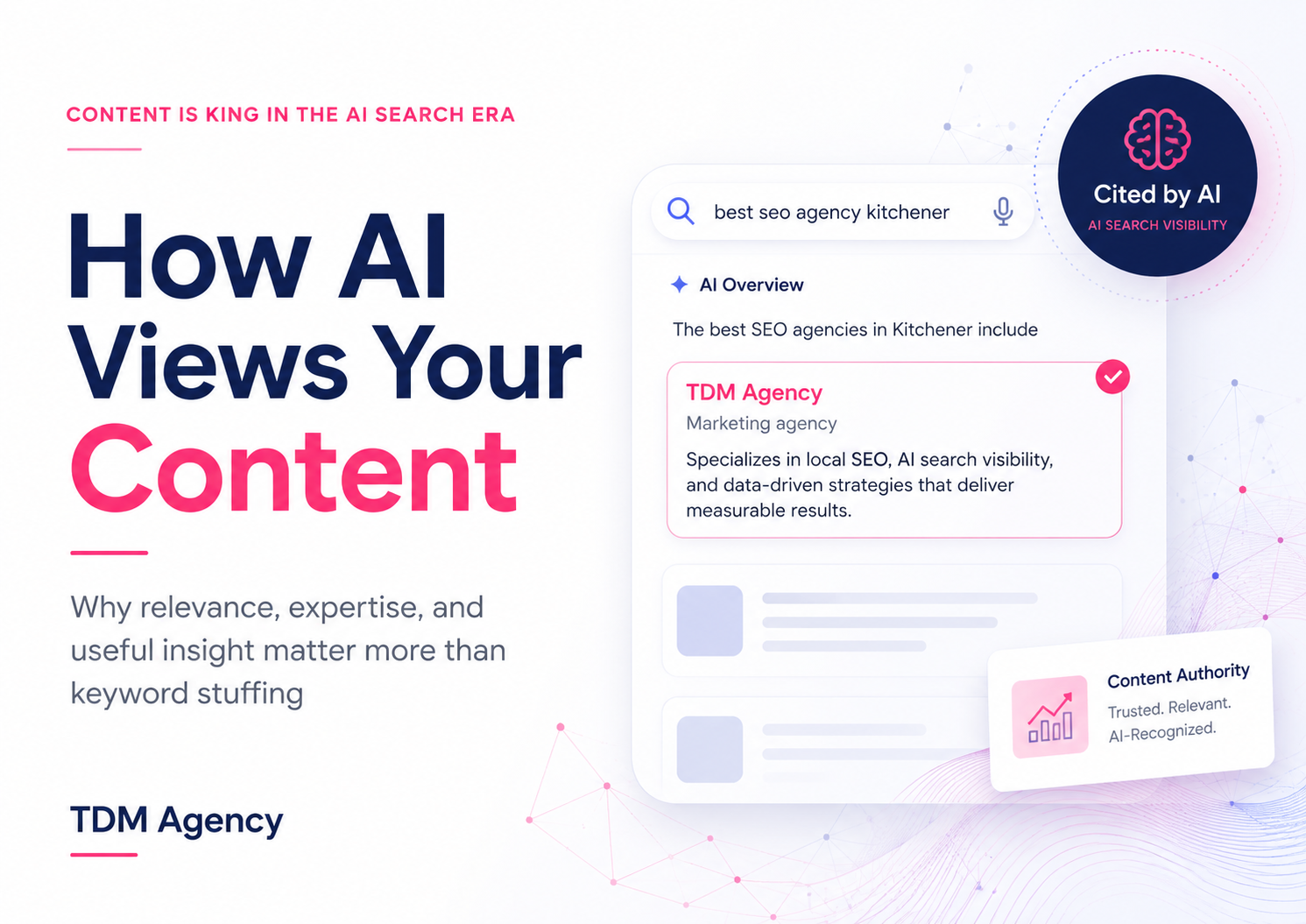
In a recent Google AI Mode result for “best SEO agency Kitchener,” TDM Agency was included among the leading local SEO providers and was highlighted for Local SEO and AI Search Visibility.
AI search results can vary by query, user location, and timing, so no individual result should be treated as a permanent ranking. However, being included in that response is a meaningful indication that Google can clearly connect TDM Agency with SEO expertise in the Kitchener market.
That visibility is not created by placing the same keyword on a page repeatedly.
It is built via consistent local information, useful service pages, credible reviews, original case studies, expert contributions, and content that answers the questions local businesses are genuinely asking.
The old approach was to write for an algorithm.
The current opportunity is to publish information that helps people so well that algorithms perceive its value too.
Because content may still be king—but relevance, expertise, and usefulness are what earn the crown.