
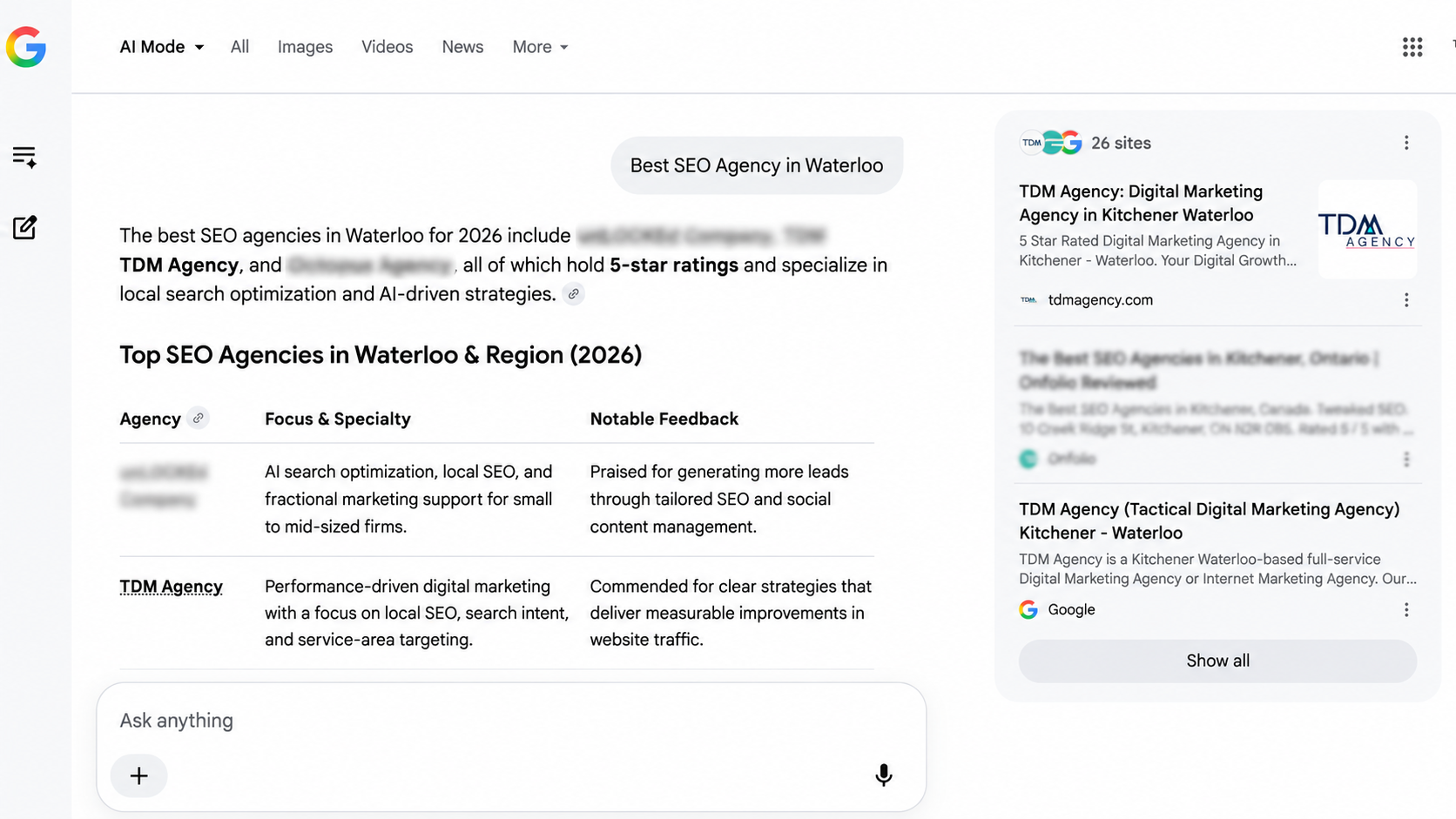
For years, SEO was easy to explain.
You wanted your business to show up when someone searched for what you offer. A plumber wanted to rank for “plumber Kitchener.” A clinic wanted to show up for “chiropractor Waterloo.” A marketing agency wanted to be found for “SEO Kitchener-Waterloo.”
That still matters.
But Google Search is changing quickly, and local businesses in Kitchener-Waterloo need to pay attention.
At Google I/O 2026, Google announced what it called the “biggest upgrade in over 25 years” to the Search box. The company is moving Search deeper into AI Mode, using Gemini to support longer questions, follow-up prompts, visual inputs, files, videos, and more conversational search behaviour.
In simple terms, Google Search is becoming less like a list of links and more like an assistant that tries to understand what someone wants and answer it directly.
That does not mean SEO is dead.
It means SEO has become more important, more local, and more trust-based.
As Anurag B, SEO Strategist at TDM Agency, puts it:
“SEO is not disappearing. It is becoming more demanding. Businesses now need to be easy for Google to understand, easy for AI to summarize, and easy for customers to trust.”
Is Google Removing the Search Bar?
Not exactly.
Google is not removing search. It is rethinking how search works.
The classic search bar has always trained people to shorten their thoughts into a few words. Instead of asking a full question, people typed things like:
Now Google wants people to ask more complete questions. Someone may search:
“Which SEO agency in Kitchener-Waterloo is best for a small local business that needs more leads?”
Or:
“Who is the best chiropractor in Waterloo for someone with lower back pain and good reviews?”
That changes how businesses need to think about content.
A page cannot just repeat a keyword anymore. It has to clearly explain the service, the location, the problem being solved, the business’s credibility, and why someone should choose that company.
Mashable’s article on Google’s Search changes explained the shift well: Search is no longer only a place to find links. It is becoming a place where AI can handle more of the user’s search journey.
For local businesses, that is a big deal.
Why AI Mode Changes SEO for Local Businesses
Google says AI Overviews now have more than 2.5 billion monthly active users, and AI Mode has passed 1 billion monthly active users.
That tells us this is not a small experiment. It is the direction Google is moving.
For Kitchener-Waterloo businesses, the impact is practical.
A customer may no longer click through 10 websites. Google may summarize options, compare businesses, pull information from reviews, scan service pages, examine local signals, and help users narrow their decision-making faster.
That means your website and online presence need to answer a few important questions clearly:
Who do you help?
What services do you offer?
Where do you offer them?
Why should someone trust you?
What makes your business different from competitors?
Do your reviews, content, website, and Google Business Profile all support the same message?
What services do you offer?
Where do you offer them?
Why should someone trust you?
What makes your business different from competitors?
Do your reviews, content, website, and Google Business Profile all support the same message?
This is where many local businesses are exposed.
They may have a website, but the content is thin. They may have service pages, but they are too generic. They may have reviews, but no clear local SEO strategy. They may rank for one term, but not for the real questions customers ask before making a decision.
That kind of SEO will struggle in the AI search era.
SEO Is Not Dead. Weak SEO Is.
Every time Google changes, people say SEO is dead.
They said it when mobile search grew.
They said it when featured snippets appeared.
They said it when Google Maps became more important.
They said it when AI Overviews launched.
They said it when featured snippets appeared.
They said it when Google Maps became more important.
They said it when AI Overviews launched.
But SEO is not dead. It is evolving.
Google’s own guidance says its systems are designed to reward helpful, reliable, people-first content rather than content created only to manipulate rankings.
That is exactly where SEO is heading.
Old SEO was often about keywords first. New SEO is about usefulness first.
Yes, keywords still matter. A page targeting “SEO Kitchener-Waterloo” should use that phrase naturally. A Waterloo page should make Waterloo clear. A Kitchener page should not confuse Google by trying to rank for every city at once.
But the real question is no longer just, “Did we use the keyword?”
The better question is, “Does this page actually help the person searching?”
Anurag B explains it this way:
“The old version of SEO was about getting found. The new version is about being understood. If your website does not clearly explain who you help, what you do, where you serve, and why someone should trust you, AI search will move past you.”
That is the shift.
The Zero-Click Problem Is Real
One concern with AI search is that fewer people may click through to websites.
That concern is fair.
AI Overviews and AI Mode can answer more questions directly on Google. If a user gets the answer they need without clicking, website traffic may drop for some industries. Publishers are especially worried about this because they rely heavily on search traffic and page views. Mashable’s article also raised this issue, noting that AI summaries and search agents may reduce the need for users to visit the original websites that informed the answer.
But for local businesses, the story is slightly different.
A homeowner still needs a plumber.
A parent still needs a dentist.
A business owner still needs an SEO agency.
A patient still needs to book with a clinic.
A homeowner still needs an HVAC company.
A parent still needs a dentist.
A business owner still needs an SEO agency.
A patient still needs to book with a clinic.
A homeowner still needs an HVAC company.
The click may happen later. The decision may be shaped earlier. But the customer still has to choose someone.
Rand Fishkin from SparkToro has written about this shift, noting that zero clicks do not mean zero sales. The customer journey is changing, but businesses still need visibility, trust, and a clear reason to be chosen.
That is the opportunity.
SEO is no longer only about traffic. It is about being visible when people are forming opinions and making decisions.
What This Means for Kitchener-Waterloo Businesses
Kitchener-Waterloo is a competitive market.
Local customers compare everything. They read reviews. They check websites. They look at photos. They ask Google. They use Maps. They compare pricing, trust, experience, and how clearly a business explains its services.
In an AI-driven search world, Google may do more of that comparison for them.
For example, someone searching for an SEO agency in Kitchener-Waterloo may not only see a list of agencies. They may see an AI-generated summary that pulls from websites, service pages, reviews, business profiles, and online mentions.
Someone searching for a Waterloo chiropractor may see information about services, reviews, location, offers, and common conditions treated.
Someone looking for a contractor in Kitchener may see companies compared based on service area, reputation, project type, and customer feedback.
This means your online presence has to be consistent.
Your website cannot say one thing while your Google Business Profile says another. Your service pages cannot be vague. Your reviews cannot be ignored. Your content cannot sound as if it were written solely to fill space.
Local SEO now needs to connect everything: your website, service pages, Google Business Profile, reviews, citations, local content, backlinks, and conversion path.
What Should Local Businesses Do Now?
1. Build Better Service Pages
Every important service should have its own strong page.
A generic “services” page is usually not enough. If you are a clinic, contractor, law firm, dentist, consultant, or home service company, your pages should clearly explain each service.
A good service page should answer:
What is the service?
Who is it for?
What problems does it solve?
Where is it offered?
What should the customer expect?
Why should they trust you?
Who is it for?
What problems does it solve?
Where is it offered?
What should the customer expect?
Why should they trust you?
This is not just good for Google. It is good for people.
2. Strengthen Local SEO Signals
If you want to rank in Waterloo, your page should clearly support Waterloo. If you want to rank in Kitchener, build a Kitchener-focused page. If you want to rank across Kitchener-Waterloo, make sure the page is written for the whole region without confusing the focus.
Local SEO signals include your location, service areas, Google Business Profile, reviews, citations, local backlinks, and content that reflects how people search in your market.
This matters even more as AI search tries to understand which businesses are relevant to a specific location.
3. Improve Your Google Business Profile
For many local searches, your Google Business Profile is one of your most important SEO assets.
Your categories, services, photos, reviews, posts, Q&A, business description, and location signals all help Google understand what your business does.
If your profile is incomplete, outdated, or inactive, you are making it harder for Google and customers to trust you.
4. Answer Real Customer Questions
AI search is built around questions.
That means your website should answer the questions your customers actually ask, such as:
How much does SEO cost in Kitchener-Waterloo?
How long does SEO take?
Is SEO still worth it with AI search?
What is the difference between SEO and Google Ads?
How do I show up in Google Maps?
Why is my competitor ranking higher than me?
How long does SEO take?
Is SEO still worth it with AI search?
What is the difference between SEO and Google Ads?
How do I show up in Google Maps?
Why is my competitor ranking higher than me?
These are not just blog topics. They are buying questions.
If your website answers them clearly, you give both Google and customers more reasons to trust your business.
5. Build Authority Beyond Your Website
Search Engine Land has advised businesses to think beyond traditional rankings and build visibility across the places where AI systems may find and understand brands. That includes topical authority, brand presence, user-focused content, and visibility across multiple platforms.
For a local business, that may include:
Customer reviews
Case studies
Local directories
Community involvement
Helpful blog content
Social proof
Industry partnerships
Local media mentions
Strong Google Business Profile activity
Case studies
Local directories
Community involvement
Helpful blog content
Social proof
Industry partnerships
Local media mentions
Strong Google Business Profile activity
The more consistent and credible your digital footprint is, the easier it becomes for Google to understand and trust your business.
What Should You Expect From an SEO Agency Now?
SEO reports are not enough anymore.
A modern SEO agency should not just send you a list of keywords and rankings. It should help you understand what is happening in your market, why competitors are winning, what your website is missing, and what needs improvement next.
At TDM Agency, we view SEO as a comprehensive visibility strategy.
That includes technical SEO, content strategy, local SEO, Google Business Profile optimization, competitor research, on-page improvements, authority building, and conversion-focused reporting.
Rankings are important, but rankings alone do not build a business.
Anurag B says:
“Ranking is still important, but ranking without trust does not create growth. The real win is when someone discovers you, understands you, believes you and takes action.”
That is where SEO is going.
The Takeaway
Google Search is changing. AI Mode, AI Overviews, and the redesigned Search box are changing how people find answers, compare businesses, and make decisions.
But this does not mean SEO is going away.
It means businesses need better SEO.
For Kitchener-Waterloo businesses, the future of SEO is about being clear, local, helpful, trustworthy, and easy to understand. Your website should answer real questions. Your Google Business Profile should support your local visibility. Your reviews should build confidence. Your content should show expertise. Your online presence should make it easy for both Google and customers to know why you are the right choice.
SEO is not dead.
It is becoming smarter.
And the businesses that adapt now will have the advantage.