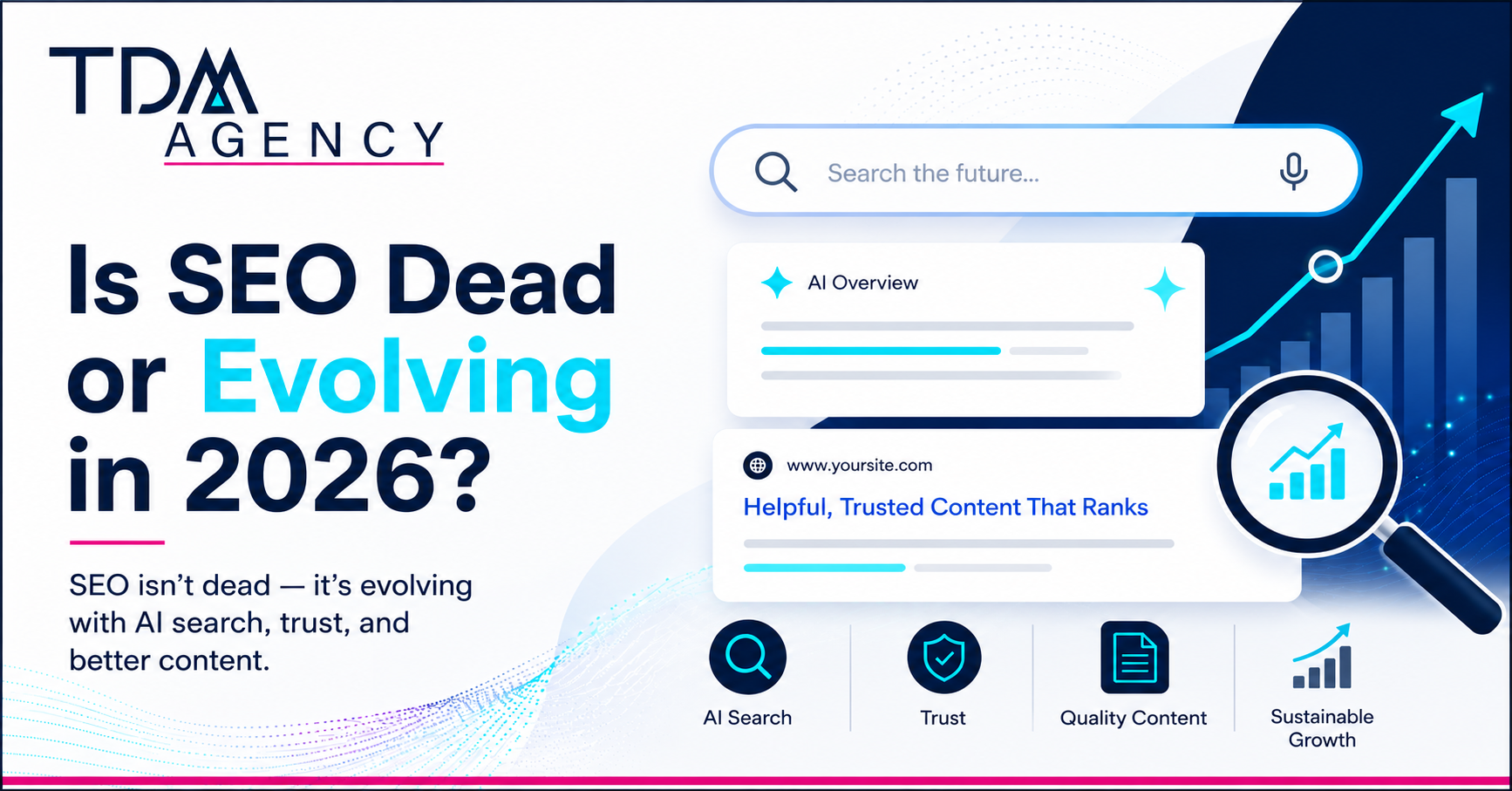
Each year, someone claims that SEO is dead.
However, when business owners review their website traffic, Google rankings, and leads, they realize that search remains one of the most effective ways for customers to find businesses.
So, is SEO dead in 2026?
No, SEO is not dead. However, outdated SEO practices are.
SEO strategies based on keyword stuffing, low-quality blog posts, mass backlinks, generic AI content, and passive approaches are no longer sufficient. Google has evolved. User behavior has shifted. AI search has changed how people find information. However, the need for businesses to be discoverable remains unchanged.
In fact, SEO may be more important now, as people search across multiple platforms, ask more detailed questions, and expect higher-quality answers.
Google’s own guidance still says the best practices for SEO remain relevant for AI features like AI Overviews and AI Mode. Google also says there are no special shortcuts required to appear in AI search features — the foundation is is still technical accessibility, helpful content, strong page experience, clear structure, and reliable information.
This highlights an important point.
SEO is not disappearing; it is becoming more demanding.
The Real Answer: SEO Has Shifted From Ranking Pages to Building Trust
For years, many businesses believed SEO simply involved adding keywords to a page and waiting for rankings.
That SEO approach is now outdated.
In 2026, SEO focuses on helping search engines, AI platforms, and customers understand three key aspects:
Who you are.
What is the best answer?
Why your business should be trusted.
Google has made it clear that its ranking systems are meant to focus on helpful, reliable, people-first content — not content created only to manipulate rankings. Google specifically asks whether content provides original information, complete answers, expert insight, clear sourcing, and substantial value compared to other search results.
This is where SEO has evolved.
Publishing a page titled “Best SEO Services” is no longer sufficient to earn Google’s trust. You must demonstrate experience, explain your process, address real questions, exhibit expertise, and build authority both on your website and across the web.
As Binod, SEO Strategist at TDM Agency, puts it:
“SEO in 2026 is no longer about chasing Google. It is about becoming the clearest, most trusted answer in your market. If your website says the same thing as everyone else, Google has no reason to choose you.”
This is the shift.
SEO is no longer a trick; it is now a trust-building system.
Why People Think SEO Is Dead
The “SEO is dead” discussion typically originates from several real changes.
First, AI Overviews now provide direct answers within Google, allowing some users to get information without visiting a website.
Second, users are searching past traditional Google results, turning to platforms such as ChatGPT, Gemini, Reddit, TikTok, YouTube, voice search, maps, forums, and review sites before making decisions.
Third, weak content is losing value. Generic blog posts that merely repeat common information are less likely to perform well.
Fourth, competition has intensified. Nearly every business now recognizes the importance of ranking on Google.
But none of this means SEO is dead.
It means SEO has broadened.
The article from The State makes a similar point: search behavior is expanding across Google, AI platforms, voice search, Reddit, and social channels, making it more important for brands to be visible wherever people are looking for answers.
This is not the end of SEO.
This represents the next stage of SEO.
Google AI Overviews Changed SEO, But They Did Not Replace It
AI Overviews are a primary reason business owners question whether SEO remains effective.
Google’s AI features can summarize complex questions, provide quick answers, and link to supporting websites. Google says AI Overviews are designed to help people understand complicated topics more quickly and then explore supporting links. Google also explains that AI Mode and AI Overviews may use “query fan-out,” meaning Google can run multiple related searches across subtopics before forming a response.
This shift requires a new approach to content creation.
A basic 500-word article that repeats a single keyword multiple times is no longer sufficient.
To appear in modern search results, a page should clearly answer the main question, address related subtopics, provide examples, define terms, include specialist insights, and be easily understood by both users and search engines.
Search Engine Land’s 2026 AI Overviews guide also notes that AI Overviews can appear in a significant portion of searches and that strong organic rankings, brand authority, credible content, and well-defined structure all improve the chances of being cited in AI-generated results.
This is why SEO is becoming increasingly strategic. You are no longer optimizing for a single keyword. You are optimizing for an entire topic.
What SEO Looks Like in 2026
Modern SEO consists of multiple essential elements.
The first is technical SEO. Your website needs to be crawlable, indexable, fast, mobile-friendly, and easy to navigate. Google’s AI feature guidance specifically mentions fundamentals such as allowing crawling, strong internal links, good page experience, visible text content, quality images and videos when useful, accurate structured data, and updated business information.
The second is content quality. Google prioritizes helpful, reliable, people-first content. Your content should answer real questions, provide original value, demonstrate expertise, and leave the reader satisfied.
The third is authority. A website gains strength when trusted websites, directories, industry platforms, media mentions, reviews, and local sources confirm the business’s credibility.
The fourth is user intent. In 2026, SEO is not only about search terms; it is regarding understanding what users truly want to know, compare, decide, or purchase.
The fifth is conversion. Traffic alone is not enough; the true goal is to turn search visibility into calls, form submissions, bookings, store visits, and sales.
As Binod explains:
“A ranking without a lead is only half the job. Good SEO should bring the right visitor to the right page and make the next step obvious.”
This is where many businesses fall short. They focus solely on rankings and overlook the customer journey.
Example: How SEO Has Evolved for a Local Service Business
Plumbers, chiropractors, dentists, roofers, moving companies, and HVAC businesses once relied on a simple SEO playbook.
Create a service page.
Add the city name.
Build a few directory listings.
Collect reviews.
These steps can still help, but they are no longer sufficient in competitive markets.
Today, those businesses require a much stronger search presence.
A plumbing company, for example, should have pages for emergency plumbing, drain cleaning, water heater repair, sump pump services, and service areas. But it should also answer real customer questions like:
Why does my drain keep backing up?
How much does emergency plumbing usually cost?
When should I replace a water heater?
What causes low water pressure?
How do I know if a plumbing issue is serious?
These questions are important because customers often search before they are ready to contact a business. By providing helpful information early, you increase both Google’s trust in your website and customers’ trust in your company.
The same applies to a chiropractor explaining back pain, a dentist explaining implants, or a moving company explaining how to choose reliable movers.
In 2026, SEO rewards businesses that educate customers before selling.Example: How SEO Has Evolved for a B2B Company
For B2B companies, this shift is even more significant.B2B buyers rarely convert after viewing a single page. They research, compare options, assess credibility, read case studies, review feedback, evaluate pricing, and seek proof.
Therefore, SEO must support the entire decision-making process.
A strong B2B SEO strategy may include:
Service pages that clearly explain the offer.
Industry pages that speak to specific verticals.
Case studies that show measurable results.
Comparison pages that help buyers evaluate options.
Educational blogs that answer high-intent questions.
Authority content from real team members.
Strong internal linking to help Google understand the full website structure.
This is why subject matter expertise is essential.
A generic article can explain what SEO is.
A strong article explains what is changing, what actions business owners should take, which mistakes to avoid, and how the strategy connects to leads and revenue.
This is the difference between content and authority.
AI Content Did Not Kill SEO — Bad AI Content Did
AI has transformed content creation, but it has not replaced expertise.
The issue is not the use of AI itself. The problem arises when businesses publish generic AI content lacking original insight, real examples, brand voice, proof, or useful takeaways.
Google’s helpful content guidance asks whether content provides original reporting, research, analysis, complete explanations, expert knowledge, and substantial value compared to other pages.
That is the standard.
If a business uses AI to mass-produce shallow blogs, its SEO performance will likely decline.
However, if a business uses AI to support research, organize ideas, improve structure, and accelerate production—while still incorporating human expertise, examples, and strategy—SEO can become more effective.
Binod says it well:
“AI can help create content faster, but it cannot replace business experience. Google does not need another generic answer. It needs the best answer.”
This is the key.
The future of SEO is not human vs. AI.
It is human expertise enhanced by better tools.
Why Brand Authority Now Matters More
SEO was once heavily focused on individual pages.
Now, it is also brand-focused.
Google and AI systems look for signals that a business is credible. Those signals can include strong website content, reviews, backlinks, mentions, consistent business listings, author expertise, case studies, media references, social proof, and engagement across trusted platforms.
This is especially important because search now occurs across multiple platforms.
A customer may find your business on Google, check your reviews, look at your social media, read a blog, compare you with competitors, ask ChatGPT for options, and then search your brand name before contacting you.
That entire journey matters.
If your brand appears weak, inconsistent, or invisible beyond your website, your SEO potential is limited.
This is why modern SEO includes digital PR, content strategy, reputation management, local citations, case studies, social visibility, and review generation.
The website is still central.
However, the brand surrounding the website now matters more.
SEO Is Becoming Search-Everywhere Optimization
One of the most significant SEO shifts in 2026 is that people no longer search exclusively on Google.
They search on YouTube for tutorials.
They search on Reddit for real experiences.
They search for quick opinions using TikTok.
They search for local businesses on Google Maps.
They ask ChatGPT and Gemini for recommendations.
They use voice assistants for quick answers.
Google’s own AI search experience is also becoming more conversational, especially with AI Mode, which allows users to ask deeper, more detailed follow-up questions.
This means SEO has evolved from ranking blue links to ensuring discoverability wherever customers search.
For businesses, this does not imply abandoning Google, which remains central. However, your content should be clear enough to quote, trusted enough to reference, and valuable enough to share.
That includes:
Clear answers.
Specialist quotes.
Real examples.
FAQs.
Structured sections.
Strong page titles.
Helpful visuals.
Updated information.
Author credibility.
Internal links.
Schema where appropriate.
Fast loading pages.
A strong Google Business Profile for local companies.
This approach prepares businesses for both traditional SEO and AI-driven discovery.
What Businesses Should Stop Doing in SEO
Businesses should stop treating SEO as a one-time checklist.
Adding keywords to a homepage is not a strategy.
Publishing random blogs is not a strategy.
Buying low-quality backlinks is not a strategy.
Copying competitor headings is not a strategy.
Posting generic AI articles every week is not a strategy.
An effective SEO strategy commences with understanding the customer, the market, the competition, the website, search intent, and business objectives.
For example, a service business does not just need traffic. It needs qualified local leads.
An e-commerce business does not just need rankings. It needs product visibility and conversions.
A B2B company does not just need blog clicks. It needs trust, authority, and sales conversations.
SEO must correspond to the business model.
This is what distinguishes effective SEO from busy work.
What Businesses Should Do Instead
Agencies seeking
SEO success in 2026 should focus on five key priorities.
First, address the technical foundation. If Google cannot crawl, index, understand, or load your website properly, all other efforts become more difficult.
Second, build topic authority. Avoid creating a single thin page on a subject; instead, develop a comprehensive cluster of helpful pages that address the main questions customers ask before purchasing.
Third, show real expertise. Include quotes, examples, case studies, author bios, process explanations, and evidence from actual client work.
Fourth, enhance conversion. Every SEO page should have a clear purpose and guide visitors toward a call, form submission, quote request, consultation, booking, or subsequent step.
Fifth, build trust beyond your website. Reviews, citations, quality backlinks, media mentions, social proof, local partnerships, and brand searches all contribute to stronger visibility.
As Binod says:
“The businesses winning with SEO now are not always the ones publishing the most content. They are the ones publishing the most useful content and backing it up with trust signals.”
This is precisely where SEO is heading.
Is SEO Still Worth It in 2026?
Yes, SEO is still valuable in 2026, but only when executed properly.
SEO remains one of the most effective long-term marketing channels because it connects your business with people actively searching for answers, products, services, comparisons, and solutions.
Paid ads stop when the budget stops.
Social posts disappear quickly.
Cold outreach depends on interruption.
SEO builds long-term visibility.
However, SEO is not instantaneous. It requires strategy, consistency, technical optimization, content development, authority building, and ongoing improvement. When executed well, it creates a compounding effect, increasing your website’s visibility, trust, and leads over time.
The businesses that struggle with SEO are usually not failing because SEO is dead.
They struggle because their SEO strategy is outdated.
The TDM Agency View: SEO Is Evolving Into a Bigger Growth Strategy
At TDM Agency, we view SEO as more than just rankings.
Rankings matter, but they are only one part of the bigger picture.
The primary goal is to help businesses be discovered by the right audience, build trust before the first interaction, and convert search visibility into concrete leads.
That means SEO today needs to include:
Technical SEO.
On-page SEO.
Content strategy.
Local SEO in which location matters.
Google Business Profile optimization.
Authority building.
Conversion-focused page structure.
Review strategy.
Search intent research.
AI search readiness.
Performance tracking.
Current updates.
SEO is no longer a single task; it is a comprehensive growth system.
In 2026, this system must be smarter, more human, and more closely aligned with real business outcomes.
The Bottom Line: SEO Is Not Dead. Ineffective SEO Is Dead.
SEO is not dead in 2026.
However, ineffective SEO is obsolete.
Thin content is no longer effective.
Keyword stuffing is no longer effective.
Mass-produced generic blogs are no longer effective.
Low-quality backlinks are no longer effective.
Ranking without a clear strategy is no longer effective.
What is thriving is smarter SEO: strategies built on helpful content, technical strength, authority, trust, user intent, AI visibility, and conversion still need to be found.
Customers still search before they buy.
Google still rewards helpful, reliable content.
AI still needs trusted sources to cite.
That is why SEO is not going away.
SEO is becoming more important, more competitive, and more closely aligned with how people make decisions.
As Binod from TDM Agency puts it:
“The question is not whether SEO is dead. The question is whether your SEO strategy is modern enough to survive how search works now.”
For businesses which adapt, SEO in 2026 remains one of the most effective ways to build visibility, trust, and consistent leads.
Don’t Ask If SEO Is Dead. Ask If Your Strategy Is Still Relevant
If your SEO strategy has not evolved in the past two or three years, it may already be falling behind.
TDM Agency helps businesses develop SEO strategies customized to how Google, AI search, and real customers behave today. From technical SEO and content strategy to authority building and conversion-focused pages, we focus on helping your business be found by those already searching.
Ready to make SEO work harder for your business? Contact TDM Agency to build a strategy that delivers visibility, trust, and qualified leads.